
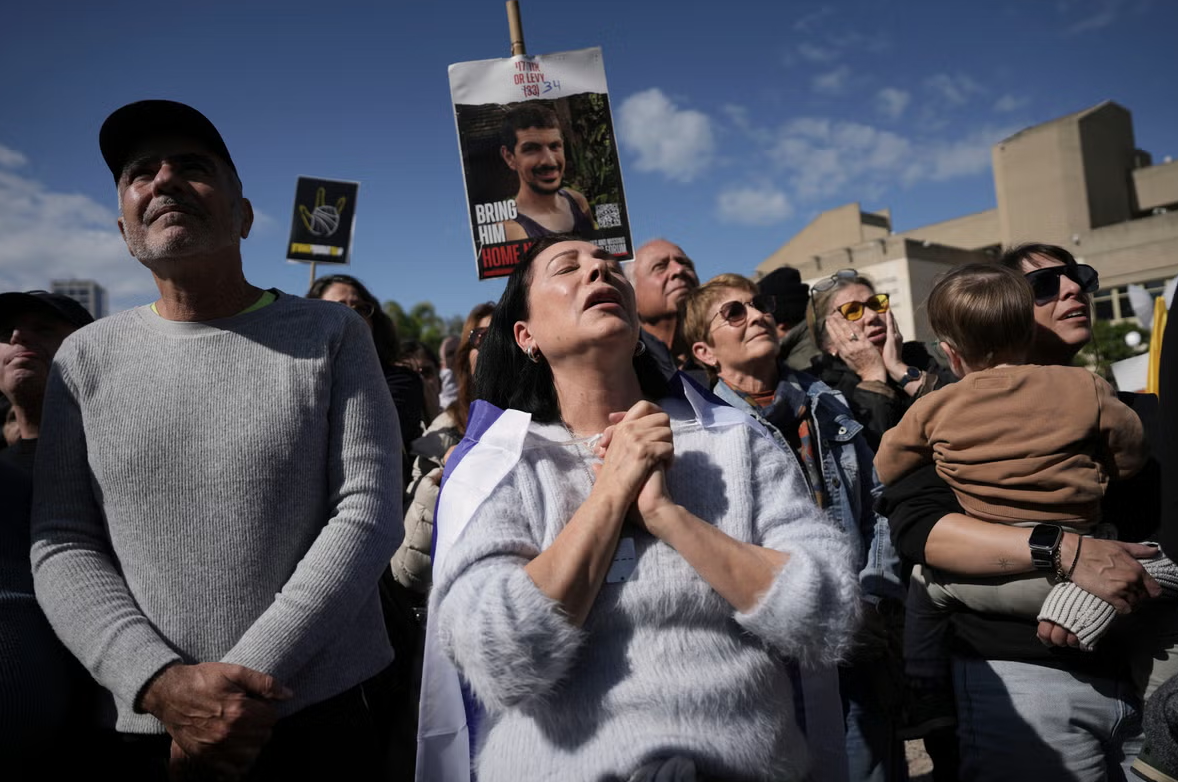
Today (15th February 2025), Hamas has released three more Israeli hostages; Sagui Dekel-Chen, Yair Horn and Alexander Troufanov, making a total of 19 Israeli hostages released so far this year under the ceasefire arrangements, with over 1000 Palestinian prisoners released in exchange. This most recent release was met with great relief as Hamas had previously said it would pause the release of hostages because Israel had violated the terms of the deal – a charge vigorously denied. This means that under the current arrangements another 14 hostages are due to be returned but since only 6 of them are thought to be alive, the mood will become increasingly dark and the situation increasingly fragile as bodies are finally returned to their loved ones. But then of course the whole thing has been terribly tragic since the terrible Hamas attack of 7th October 2023 when 1200 Israeli’s were savagely killed leading to the ruin of Gaza and the loss of many thousands of Palestinians through the Israeli military response. The physical pain, suffering and psychological trauma of those held captive on both sides has become clear with each subsequent release and we will all be thankful when the hostages have been released and as peace is established.
In recent times, the world in which we live has become increasingly dark, sinister and violent and there can be no doubt that many would describe the anger, hatred and violence that we see as evil. The Christian would equate this darkness with our human, natural capacity to sin which is a product of our fallen nature and our selfish desire to put ourselves first, often at the expense of others. Indeed, self-centred people seldom see, care or recognise the needs of others. Sin of this sort is self-perpetuating – one bad deed leads to another, either to satisfy a personal or collective greed or ambition, or to retaliate, seeking vengeance and getting one’s own back. In a sense we are all held captive and chained to the dark side of our sinful nature which ruins both our lives and that of our society.
However, the Bible tells us that the love of God is greater and even more powerful than sin, as demonstrated in the life and person of Jesus Christ. His compassionate love and grace ‘for the fallen’ is clearly a model for us all to live our lives by. But it his willingness to literally ‘step into our place’ and to die upon the cross which highlights and demonstrates just how much his selfless sacrificial love drove him ‘to set the captives free’ (Isaiah 42.7). This is illustrated in the fact that upon his arrest, a notorious criminal called Barabas was released in Jesus’ place! It is neatly summarised in the 4th verse of that famous hymn, ‘And can it be’ by Charles Wesley:
Long my imprisoned spirit lay
fast bound in sin and nature’s night;
thine eye diffused a quickening ray –
I woke, the dungeon flamed with light;
my chains fell off, my heart was free.
I rose, went forth, and followed thee.
This is a wonderful freedom which is available to all who put their faith in Christ, so please embrace it.
The Spirit of the Sovereign Lord is on me, because the Lord has anointed me to preach good news to the poor. He has sent me to bind up the broken-hearted, to proclaim freedom for the captives and release from darkness for the prisoners. Isaiah 61.1




 Stephen Thorp